









Skip to content
Exit Advisory Group

Exit & succession planning

Exit & Succession Planning

You will step back from your business one day, whether that is around the corner or ten years out. Plan for it early, and you leave on your terms rather than the market’s.

  • Australian Financial Services Licence 700378
  • Registered Business Valuer
  • Member, Australian Institute of Business Brokers
As featured in
Australian Financial ReviewForbesSmartCompanyFinancial StandardDynamic BusinessYahoo FinanceThe CEO MagazineFirst 5000

Exit planning is the work of getting your business, and you, ready for the day you step back, so it happens on your terms and not the market’s.

Whether that day means a sale, family succession or a management buyout, starting early, ideally three to five years out, is what lets you leave on your terms. We’re here to help you understand when to start, the options open to you, how it works, and what you receive.

When to start

When should you start exit or succession planning?

Usually earlier than you would expect. The more time you have, the more you can do to build the value, reduce the business’s reliance on you, and choose your moment rather than the market’s.

81%

of sellers said they wished they had spent more time preparing

70%

started preparing less than two years before exiting

61%

believed a lack of preparation cost them money

Time is the one advantage you cannot buy back later.Figures from Exit Like an Expert.

You may be ready for this conversation if

  • You are three to five years, or more, from wanting to step back
  • You are weighing a sale, family succession, or backing your management team
  • You have no obvious successor yet and want to create one
  • You have received an unsolicited approach and want to know what your options really are
  • You want to de-risk: less owner-dependence, cleaner numbers, a stronger team
  • A change in health, family or partnership has moved the timeline forward

Business succession planning

Business succession planning: is it the right path for your business?

Business succession planning is the process of deciding who takes over your business, and preparing the business and its people for that handover. That successor might be the next generation of your family, a co-owner or business partner buying you out, or your management team through a buyout. It can also mean a sale to a financial or strategic buyer. The right path depends on your goals, your successor options and your timeline, and it is rarely obvious at the outset.

We treat business succession planning as one part of the wider exit-planning picture, not a separate discipline. The same VALUE360™ assessment and the same senior team carry through, whichever path you choose.

Read our guide to business succession planning

Your exit strategy

What your exit plan weighs up

A good exit plan is about more than the number. These are the five factors we work through with you before you settle on a path, so the exit fits your business, your timing and your life.

The five factors of an exit strategy, arranged around a central Your Exit hub.

Your Exit

Your options

Exit options at a glance

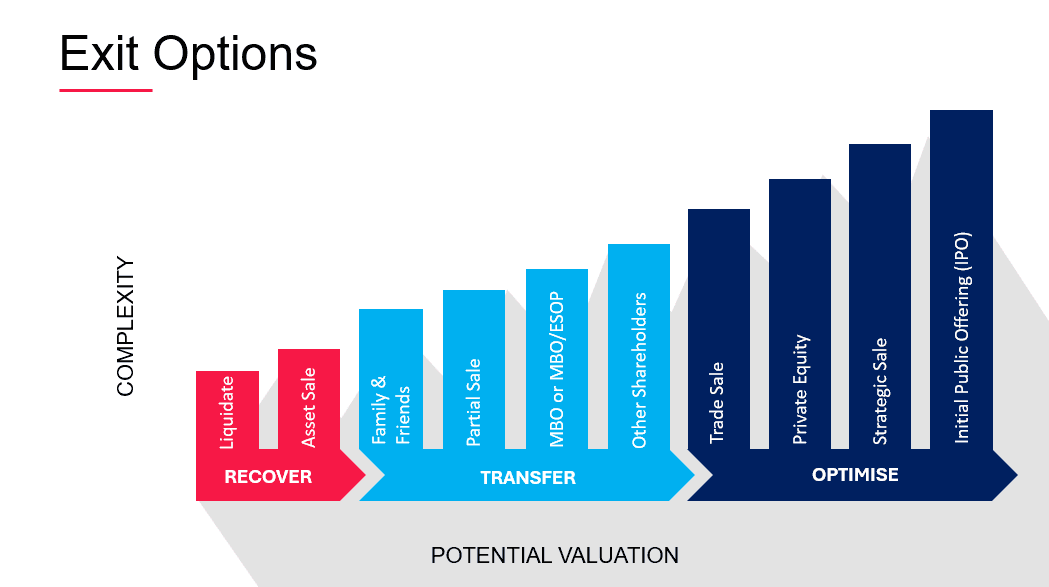
Once you know what matters most, these are the paths open to you, ranged here by complexity and the value they typically unlock. Each suits a different owner; the table below breaks down who each one suits and what to weigh.

Exit options ranged by complexity and potential valuation. Recover: liquidate, asset sale. Transfer: family and friends, partial sale, MBO or MBO/ESOP, other shareholders. Optimise: trade sale, private equity, strategic sale, initial public offering.
Exit options compared: trade sale, sale to a financial buyer, management buyout, family succession and a staged exit
PathWho it typically suitsWhat to weigh
Trade saleOwners wanting the highest achievable price from a strategic buyer who values the business, its customers or its market position.Usually the strongest price; due diligence and integration can be more involved.
Sale to a financial buyerOwners wanting a clean exit to an investor or private equity buyer, sometimes with an option to retain a minority stake.Buyer will focus heavily on transferable value and management depth.
Management buyoutOwners with a capable internal team ready to take on ownership and continuity matters to staff and customers.Financing the buyout and agreeing a fair price both take real work.
Family successionOwners who want to keep the business in the family and have a successor able and willing to take it on.Fairness across children in and out of the business, and the tax and structure, need care.
Staged exitOwners not ready for a clean break, who want to sell down over time and stay involved.Slower to full liquidity; the terms of each stage need to be right.

The process

How exit and succession planning works

A good exit is a planned one. Here is how we build the plan, and how the same senior team carries it through to the deal.

  1. Clarify what you want

    We start with your life goals and timeline, then work back to what the business needs to deliver them. The plan is anchored to the life you want, not just a number.

  2. Weigh your options

    Trade sale, sale to a financial buyer, management buyout, family succession, or a staged exit where you sell down over time. We set out the trade-offs of each path honestly, including the uncomfortable ones.

  3. Assess readiness with VALUE360™

    We score the business across the five dimensions a buyer examines in due diligence: Financial Performance, Growth System, Fulfilment System, People & Leadership, and Operating System. That shows exactly where value leaks and where it is strong.

  4. Close the gaps

    You get a prioritised roadmap for the time you have: the numbers to tidy, the reliance on you to reduce, the structure and team to strengthen, so the business is ready when you are.

  5. Execute with support

    When the time comes, the same senior adviser and broker run the valuation, the sale or the transition through to completion, and protect the outcome. Plan and execution under one roof.

Why choose us

Senior advisers who plan the exit and run the deal

Exit and succession planning only matters if someone can carry it through to the deal itself. You work with the senior adviser the whole way, not a junior team.

The Exit Advisory Group advantage

Plan and execution under one roof

We build the plan, then run the valuation, the sale or the transition when the time comes. Many advisers plan a succession and refer the transaction out; the adviser who scopes your plan here is the one who sees it through to completion, so nothing is lost in the handover.

Simon Bedard, Managing Director of Exit Advisory Group and Registered Business Valuer

Simon Bedard, Managing Director. Simon is the National Chair of the Australian Institute of Business Brokers (AIBB), a Registered Business Valuer (RBV), a Licensed Business Broker, and the author of Exit Like an Expert. He hosts the Buy Grow Sell podcast. He has started, bought and exited companies himself, so the advice comes from someone who has been on your side of the table.

Simon leads a senior team, including Chartered Accountants with decades of experience across the Big Four accounting firms and the major banks, so the numbers behind your plan and your deal get accounting-grade rigour.

Meet the team
AFSL 700378Australian Financial Services Licence
Exit Advisory Group holds Australian Financial Services Licence (AFSL) 700378, granted by ASIC. That oversight sits behind every engagement and gives your plan and your deal added standing with financiers, regulators and buyers.
RBVRegistered Business Valuer
An accreditation recognised by the AIBB for specialists who value businesses to a professional standard, so the number behind your plan holds up with buyers, banks and the ATO.
AIBBAustralian Institute of Business Brokers
The national body for licensed business brokers in Australia. Simon Bedard is its National Chair.
IVSInternational Valuation Standards
Where a valuation forms part of your plan, it is prepared in accordance with the International Valuation Standards (IVS), the internationally recognised benchmark for how a business is valued.

Discretion matters most in a family or succession matter. Every conversation is strictly confidential, and the advisers who build your plan are the ones who run your deal.

Recognised

Bx Business Excellence Awards, Business Consulting Company of the Year 2024Australian Small Business Champion Finalist 2024 and 2025Business NSW Regional Finalist 2024

Proof

What early planning delivers

~45%
above initial valuation estimates
10 months
to market for the Brooks Australia sale
5 years
planning-to-sale engagement
Brooks Australia, a family-owned fire detection business acquired by Ei Electronics

Case study · Brooks Australia

A second-generation succession, planned over five years

Brooks Australia was the leading supplier of fire detection products in Australia and New Zealand, family-owned and into its second generation. Exit Advisory Group ran the valuation first, then made specific recommendations to lift transferable value, which the family implemented over the following years. When the business was ready, we ran the sale to Ei Electronics: the offer came in almost 45% above initial valuation estimates, and the sale completed 10 months after going to market.

Read the Brooks Australia case study


BrandMatters, a brand consultancy sold to a vision-aligned buyer

Case study · BrandMatters

A succession sale to a vision-aligned buyer

A founder-led brand consultancy wanted to hand the business to a buyer who would respect what it stood for and carry it forward. We ran a confidential, targeted process to find a genuinely aligned acquirer, so the founder could step back knowing the business and its people were in the right hands.

Read the BrandMatters case study
Exit Advisory Group are true professionals when it comes to guiding people on how to get ready for a business sale. Their advice and support were instrumental throughout the different stages of our business journey. From our business valuation to exit, we felt we were in very capable hands.
Emily HeeleyEmily HeeleyBusiness owner
Simon Bedard and the Exit Advisory Group team did a brilliant job assisting me in the sale of my consulting business. I couldn’t be happier with the result, delivered through their depth of understanding, and complete professionalism throughout.
Paul NelsonPaul NelsonFounder & MD, Fuller Brand Communications

What’s included

What you get: your Exit Plan

Exit planning with us produces one thing above all, a practical Exit Plan: a step-by-step roadmap to the exit you want, built around where your business is today. Here is what it includes.

  • Exit options analysis aligned to your goals and timeline
  • An exit-readiness assessment and gap plan, scored with VALUE360™
  • A succession and transition roadmap for your chosen path
  • Clear timeline and value targets to work towards
  • Ongoing advisory through to the exit itself, with the same senior team

Every engagement is scoped to your business in a confidential, no-obligation conversation. We talk through where you are, what the right path looks like, and the sensible next step. Scope is agreed privately, one to one.

Start a confidential conversation

A private, no-pressure conversation with a senior adviser. Not a sales pitch. We talk through your situation, the paths open to you, and the right next step for you.

Start a confidential conversation about your exit

Confidential · No obligation · Speak directly with a senior adviser

Not ready to talk yet? Take the Exit Readiness Score

Prefer to start on your own? Read Exit Like an Expert

Every conversation is strictly confidential, and there is no obligation. You work directly with Simon Bedard and our senior team, not a junior team, and the advisers who build your plan are the ones who run your deal. Your financials, your plans, and even the fact that you have engaged us are never disclosed.

Common questions

Exit and succession planning FAQs

Still have questions? Talk to a senior adviser on a confidential call.

When should I start exit planning?

Ideally three to five years before you want to step back, and sooner if you can. The earlier you start, the more time you have to build value, reduce the business's reliance on you, and shape it into something buyers compete for. From the book: 70% of sellers started preparing less than two years before exiting, and most wished they had started earlier.

How long does exit planning take?

The planning itself can begin in weeks, but the value it delivers depends on your lead time. Think of it in two parts: the plan, which we can build quickly, and the runway, the years over which you implement it. A longer runway is what turns a fair result into a strong one, which is why we encourage owners to start well ahead of any deadline.

What are my exit options?

The common paths are a trade sale to a strategic buyer, a sale to a financial buyer or investor, a management buyout, family succession, or a staged exit where you sell down over time. Each has different trade-offs on price, timing, tax and control. We help you weigh them against your goals before you commit to any one of them.

How does family business succession planning work?

Family succession blends the commercial and the personal, so it needs both handled with care. We work through who takes over, how to be fair across children who are and are not in the business, the tax and structure, and how to retain key non-family staff through the change. Surveys vary, but only around 30% to 45% of businesses pass from the first to the second generation, so the planning matters.

What if I have no successor?

That is common, and it is not a dead end. If there is no family or management successor ready, a trade sale or a sale to a financial buyer is often the better path, and part of the planning work is preparing the business, or a capable manager, so you have a genuine choice rather than a forced one.

Is my information kept confidential?

Yes. Every engagement is strictly confidential, governed by a confidentiality agreement. Your financials, your plans, and even the fact that you have engaged us are never disclosed. That matters most when staff, family members, partners or competitors should not know you are exploring your options.

What are your credentials to advise on this?

Simon Bedard is a Registered Business Valuer and the National Chair of the Australian Institute of Business Brokers, and the author of Exit Like an Expert. He leads a senior team that includes Chartered Accountants with decades of experience across the Big Four accounting firms and the major banks. Where a valuation forms part of your plan, it is prepared in accordance with the International Valuation Standards (IVS).

Still have questions? Start a confidential conversation

Have a confidential conversation about your exit

A conversation with a senior adviser, not a sales pitch. We will give you an honest read on where you are, the paths open to you, and the right next step. No fee, no obligation, no pressure.

Or start with the book: Exit Like an Expert